“Watch out for the snake on your left!” yelled the guide, grabbing my arm and pulling me away.
I turned just in time to see a thin green snake glistening as it glided along the branches of a tree, only inches from my face. I quickly moved to the center of the narrow pathway and resolved to stay there. I have harbored an irrational fear of snakes since early childhood.
To add to my discomfort, I had dressed—per guidebook recommendations—in a long-sleeve shirt, long pants, and a hat, and had slathered sunscreen and insect repellent on every exposed inch of skin. What I hadn’t accounted for was the oppressive heat and humidity, which rendered my carefully chosen outfit a complete disaster. My clothes clung to me, my glasses fogged over, and sweat streamed down my face into my eyes, stinging and burning.
We were trekking through a dense tropical rainforest on our way to the pyramids of the ancient Mayan city of Tikal. Our journey had begun before dawn at our resort on the outskirts of San Ignacio, Belize. A minivan had picked us up in the early morning darkness, and a short drive along a well-paved road brought us to the Guatemalan border. We disembarked and walked into a small cement building where Belizean guards examined and stamped our passports.
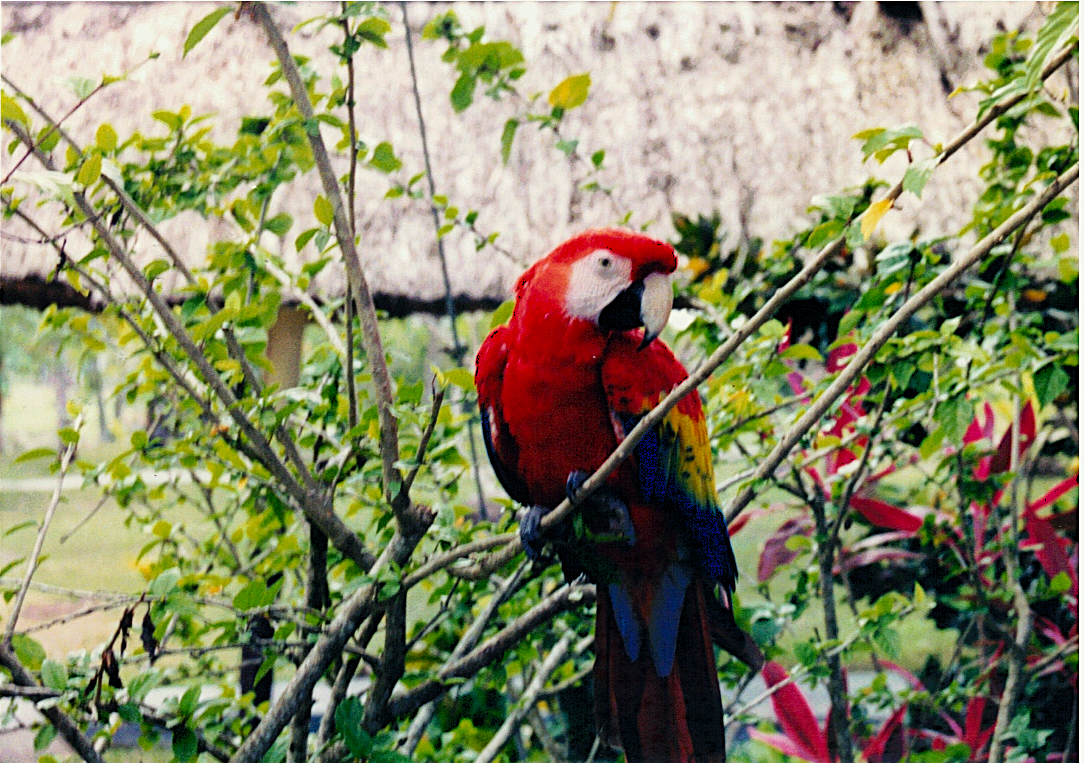
Scarlet Macaw, Belize
Our driver bid us farewell, gesturing toward the other side and assuring us he would be waiting upon our return. We stepped into the open clearing that separated the two countries. The sun had just risen, yet the air was already heavy with heat and humidity. In the distance, we could see a ramshackle hut and a few figures standing nearby. One of them waved. I assumed he was our guide.
After about fifteen minutes of processing—passport checks, photo comparisons, and official stamps—we were waved through. The guide, who had been waiting patiently, greeted us warmly and led us to a parked SUV. We settled into the back rows while he and the driver took the front seats.
The road ahead was unpaved, dusty, and deeply rutted—this, we were told, was a highway. As we jolted forward, the guide began to narrate, offering a brief history of Mesoamerica and the Maya civilization.
We were traveling through the western highlands of Guatemala, a region predominantly inhabited by indigenous Maya communities. It had only recently emerged from a brutal civil war that lasted from 1960 until just before our visit in 2000. During those decades, the region had been neglected, and the highway we were traversing—CA-13—had fallen into disrepair. Even now, two years after the war’s end, it was considered unsafe, with reports of sporadic attacks by rogue guerrilla groups.
The conflict itself had its roots in deep inequalities—between indigenous laborers who worked the land and wealthy landowners supported by powerful American corporations. It led to allegations of genocide, with estimates of up to 200,000 lives lost. In a country of roughly nine million people, that would be equivalent to the loss of seven million Americans—a staggering human toll.
Despite the road’s condition, the landscape was breathtaking. Dense forest stretched endlessly, a rich, almost impenetrable green. A swift river ran alongside us for much of the journey. Along its banks, women washed clothes and bathed, while children splashed and played in the clear water.
The roughly sixty-mile journey took more than three hours. At last, we arrived at the outskirts of the national park that shelters the ruins. After purchasing tickets, our guide led us onto a jungle trail.
Though hot, damp, and increasingly uncomfortable, I couldn’t help but marvel at the surroundings. Coatis—small, raccoon-like creatures—darted across our path, while howler monkeys leapt between towering ceiba trees above, filling the air with their eerie, guttural calls.
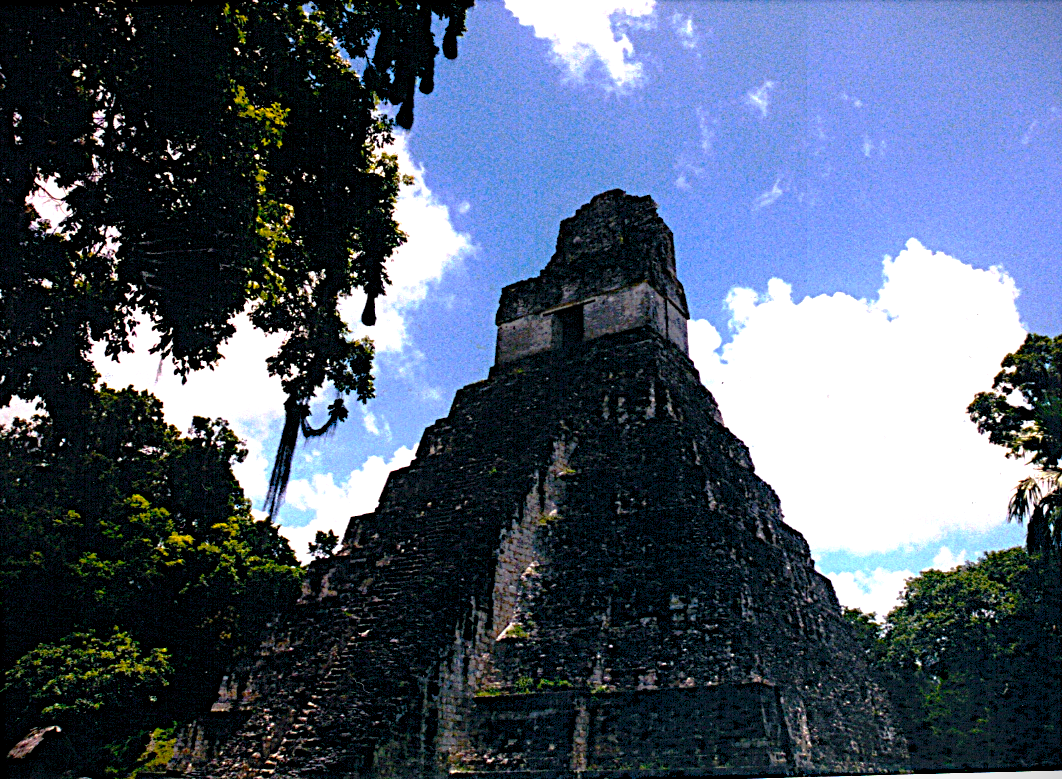
Eventually, we entered a clearing marked “Complex Q,” where we caught our first glimpse of the ancient world we had come to see. Two excavated stone pyramids stood opposite each other, aligned east and west, surrounded by upright stone markers. Each was a symmetrical, four-sided structure with a flat summit and steep stairways leading upward. These complexes, we learned, were constructed every twenty years to commemorate a king, and many such structures are scattered throughout Tikal.
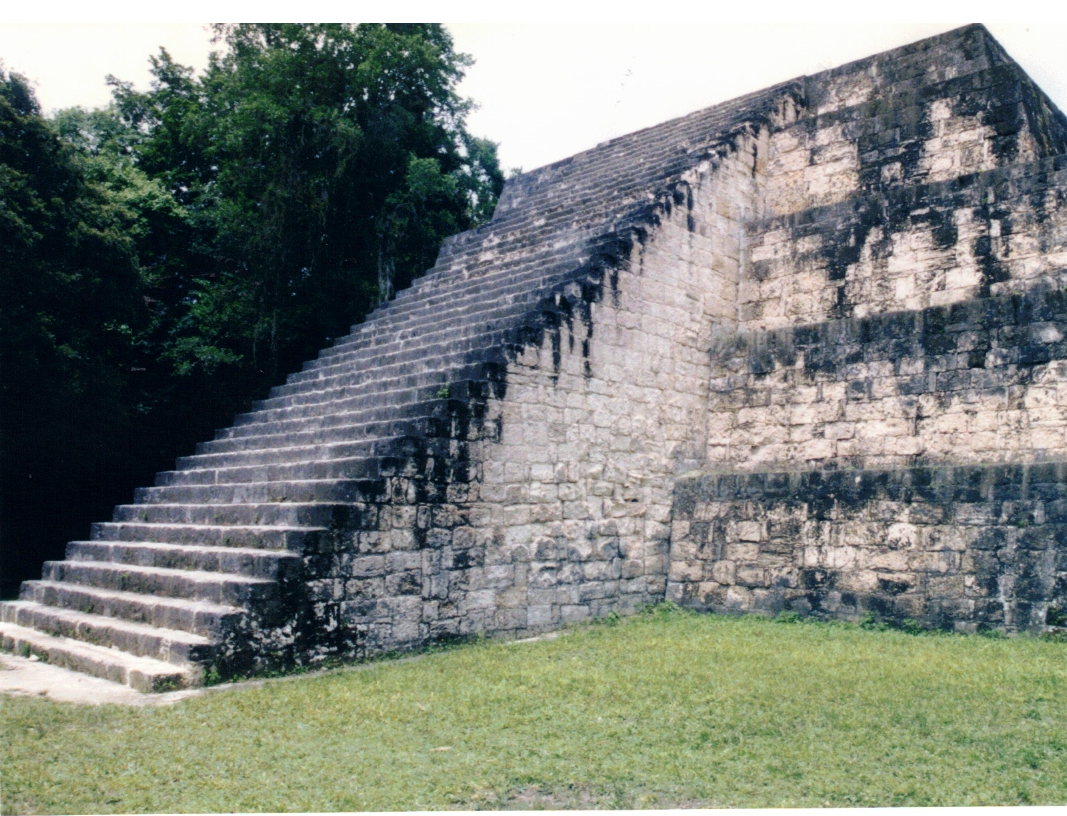
Stone Pyramid in Complex Q, Tikal, Guatemala
Around us lay numerous vegetation-covered mounds. According to our guide, these were buried temples, pyramids, and other structures still awaiting excavation.
Tikal itself is vast, with a history that stretches back millennia. Archaeologists now believe the Maya first settled here around 1000 BCE. The city flourished during the Classic Period, between 250 and 900 CE, when most of its grand structures were built. At its peak, Tikal was one of the largest pre-Columbian cities in the Americas, with an estimated population of nearly 90,000.
It maintained complex relationships—trade alliances and later conflicts—with the powerful city of Teotihuacan in present-day Mexico. The ruins uncovered thus far reveal a sprawling urban center covering more than six square miles, with over 3,000 structures built on elevated ground and connected by raised causeways spanning swampy terrain. Then, sometime in the late ninth century, the city was mysteriously abandoned, part of the broader collapse of the Maya civilization.
Walking through the jungle, it is difficult to grasp the scale of Tikal. The dense vegetation obscures much of the view. Only when you climb to the top of a structure and see temple spires rising above the canopy do you begin to understand its immense size.
We soon reached the Gran Plaza, where the 154-foot Temple I (the Temple of the Jaguar) faces the 125-foot Temple II (the Temple of the Mask) across a wide grassy expanse. To the north stands the imposing Acropolis del Norte, a complex of structures rich in history and significance.
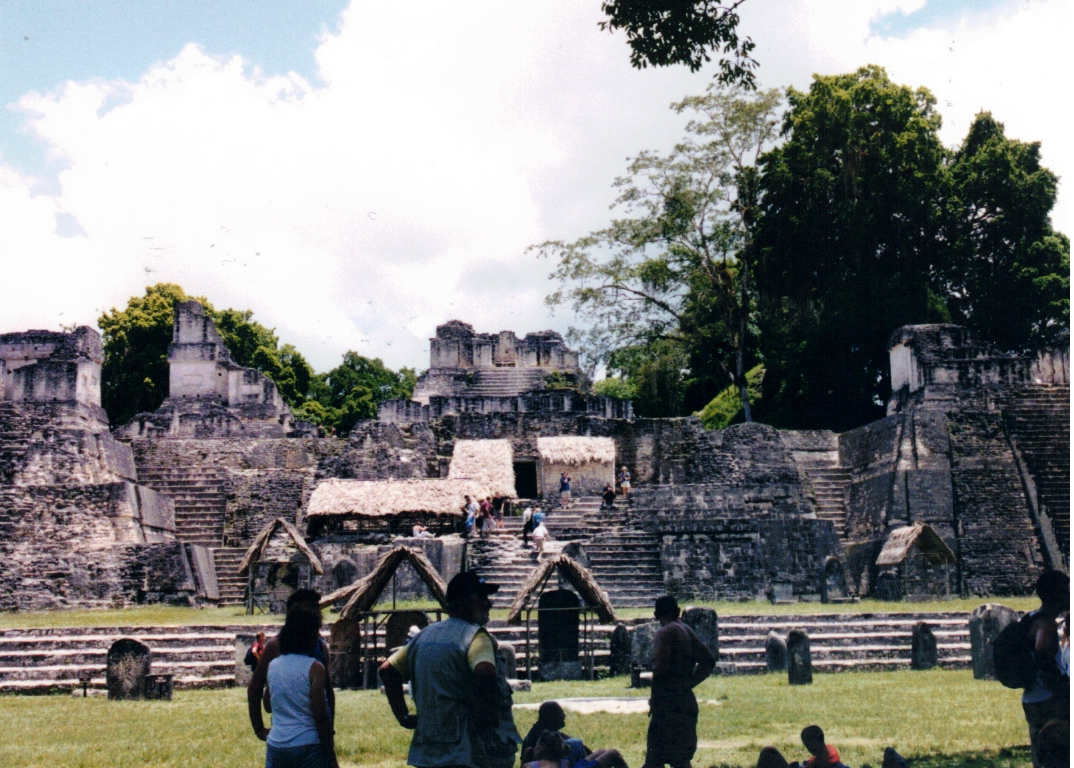
The Gran Plaza, Tikal, Guatemala
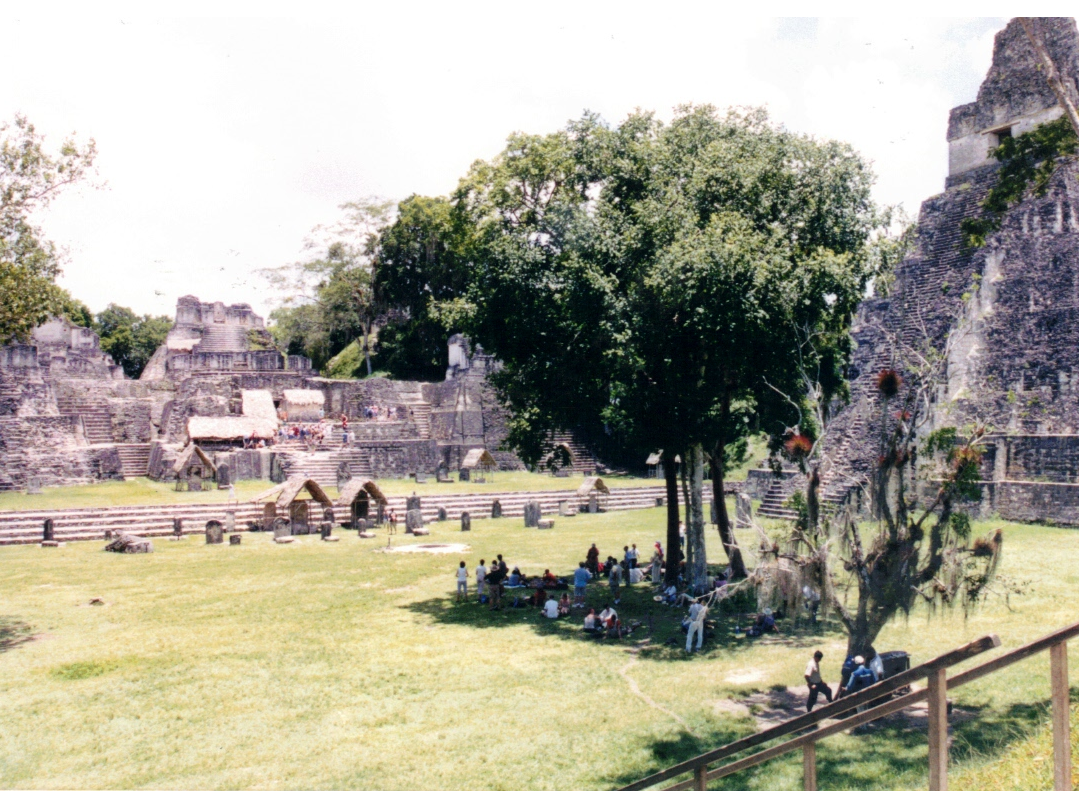
Gran Plaza, Tikal, Guatemala
We climbed its steep stone steps and were rewarded with sweeping views of the plaza below. Wandering through its interconnected chambers, we saw burial tombs and what had once been the residences of the elite. In the distance, the partially excavated Temple III—the Temple of the Jaguar Priest—rose above the treetops.
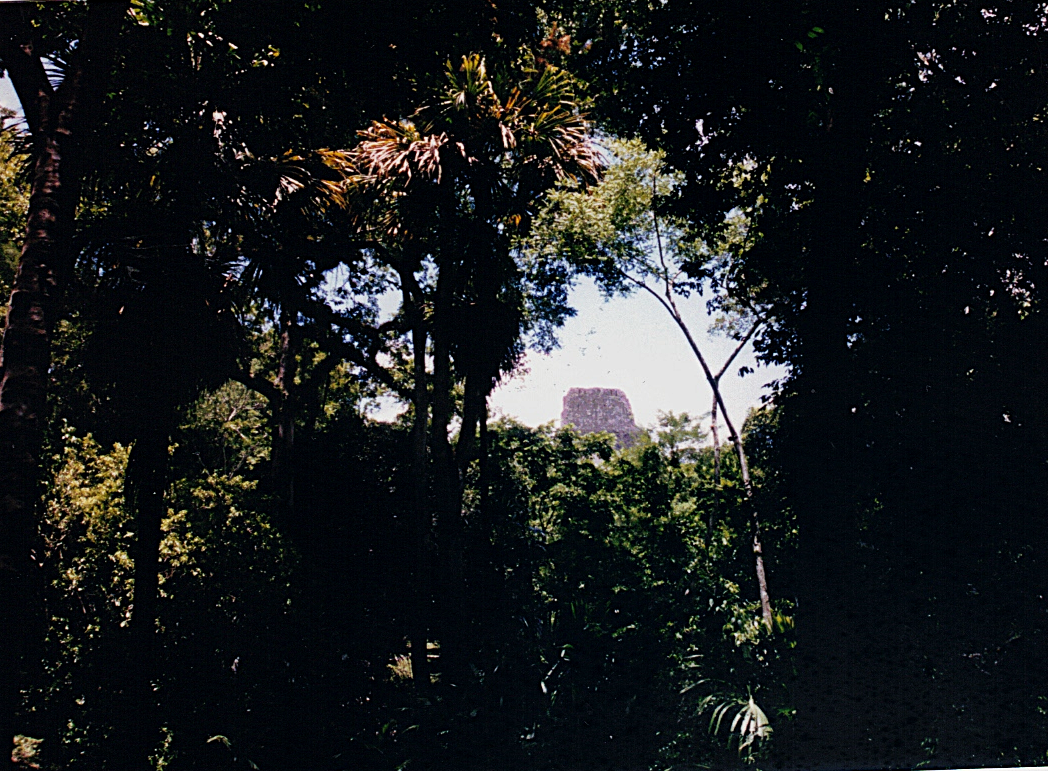
View of the top of Temple III, Tikal, Guatemala
From there, we made our way to the most impressive structure of all: Temple IV, the Temple of the Two-Headed Serpent, soaring to a height of 230 feet. Before the construction of the Empire State Building, it was among the tallest structures in the New World.
Hidden by dense vegetation, it remained invisible until we stood almost directly beneath it. Looking up, we were confronted with its staggering height. A steep wooden staircase had been built alongside the pyramid, and we began the ascent. It was not for the faint of heart. Though sturdy and equipped with railings, the climb was daunting, and looking down was unsettling.
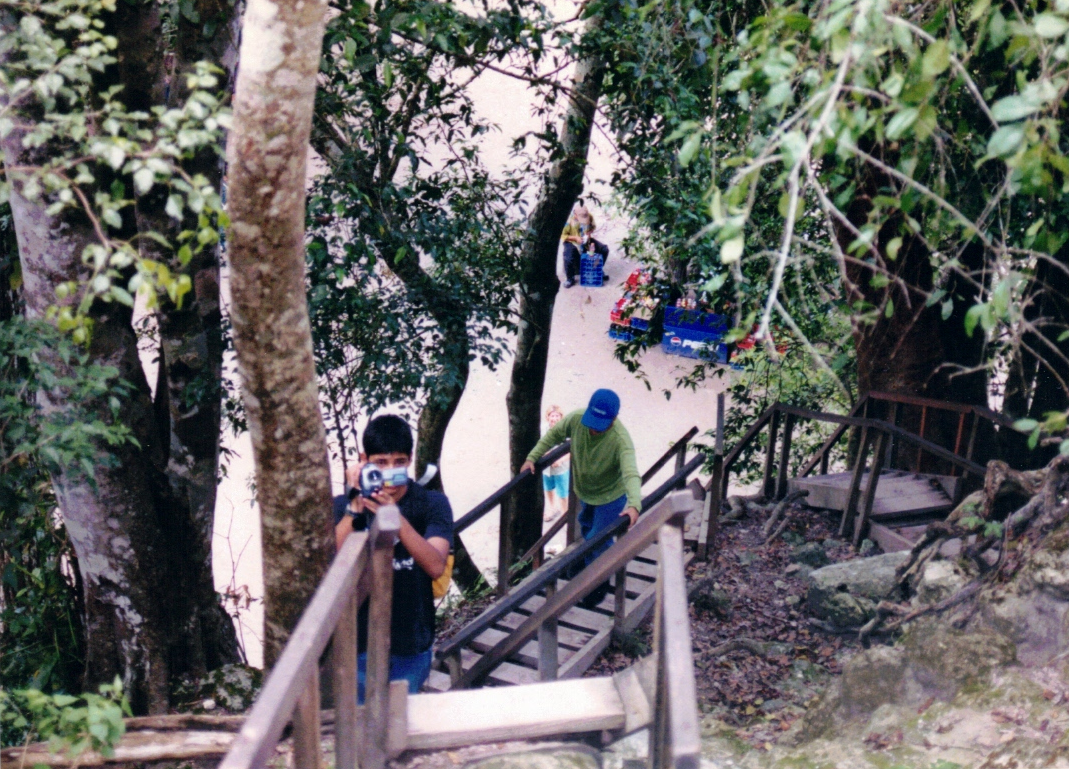
The steep wooden staircase to the top of Temple IV, Tikal, Guatemala
But the reward at the top was extraordinary.
As we rose above the canopy, the jungle stretched endlessly in every direction—a vast green ocean punctuated by the stone peaks of distant temples. The view was unforgettable. It was here that George Lucas had filmed scenes for the Rebel base in the original Star Wars. Ever since watching that film as a teenager, I had dreamed of seeing this very landscape.
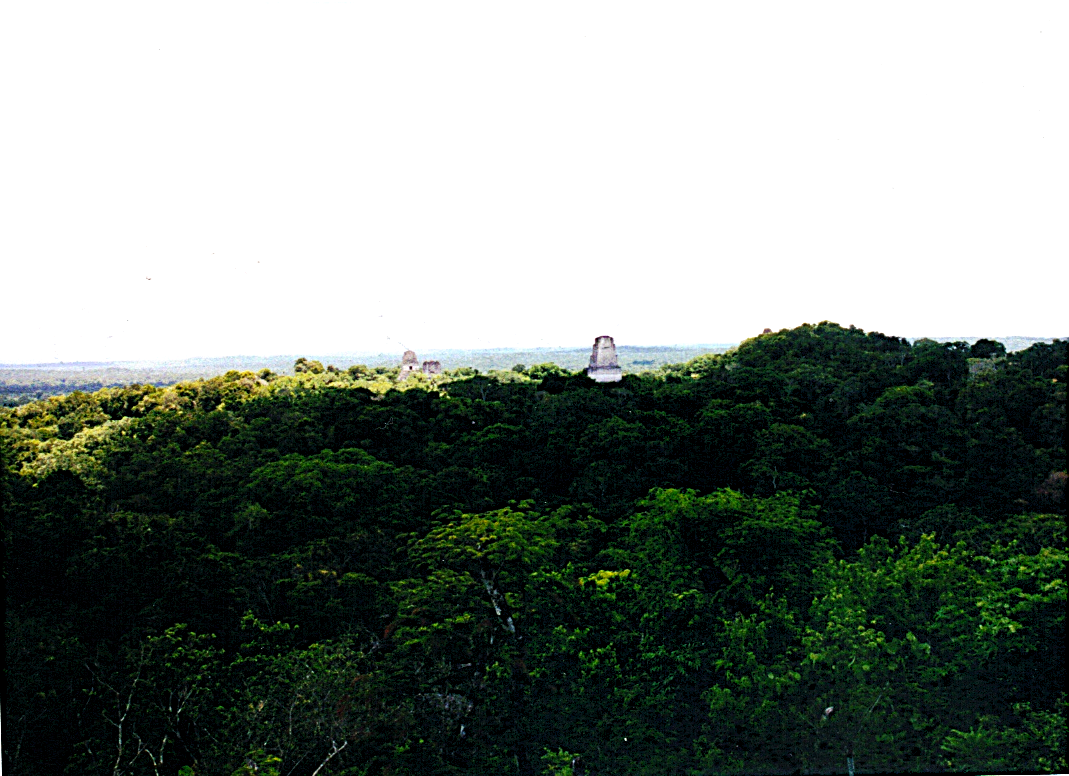
The extraordinary panoramic view from the top of Temple IV, Tikal, Guatemala
We moved onto a narrow ledge just below the summit and sat with our legs dangling over the edge. Below us, monkeys darted through the treetops, occasionally pausing to observe us. A cool breeze swept past, drying the sweat from our skin. In that moment, suspended between earth and sky, I felt utterly exhilarated.
The experience was transformative.
As the sun began its descent, the ancient stones glowed with a fiery red hue. A profound stillness settled over me, accompanied by an almost spiritual awakening. I imagined the city as it had been twelve centuries earlier—alive with movement and ritual. Priests offering sacrifices. Torches flickering to life as dusk approached. A civilization at its height.
My reverie was abruptly broken when someone pointed down below. Our guide was waving urgently, tapping his watch and signaling for us to descend. Reluctantly, I understood—it was time to leave.
The return journey was uneventful, though the forest that had seemed so vibrant in the morning now felt dark and foreboding. With no streetlights and thick clouds obscuring the sky, the only illumination came from our vehicle’s headlights. We were aware of the real dangers that lurked along this route, with reports of nighttime robberies not uncommon.
Fortunately, we encountered no trouble. After about three and a half hours, the faint, flickering lights of the border post appeared ahead. Within thirty minutes, we were back at our resort. The ancient city we had just left behind already felt distant—like a dream from another world, another time.
Years later, I read about recent LiDAR surveys revealing that Tikal may be far larger than previously thought. More than 60,000 hidden structures have been identified beneath the forest canopy in the surrounding region. At its peak, Tikal may have rivaled the great cities of Europe and Asia.
In the years since our visit, the highway has been repaired. What was once a grueling journey now takes just two hours from San Ignacio.
But I suspect the experience itself—the sweat, the fear, the wonder, the awe—remains unchanged.