An Unforgettable Birthday, a Treacherous Descent, and 25,000 steps
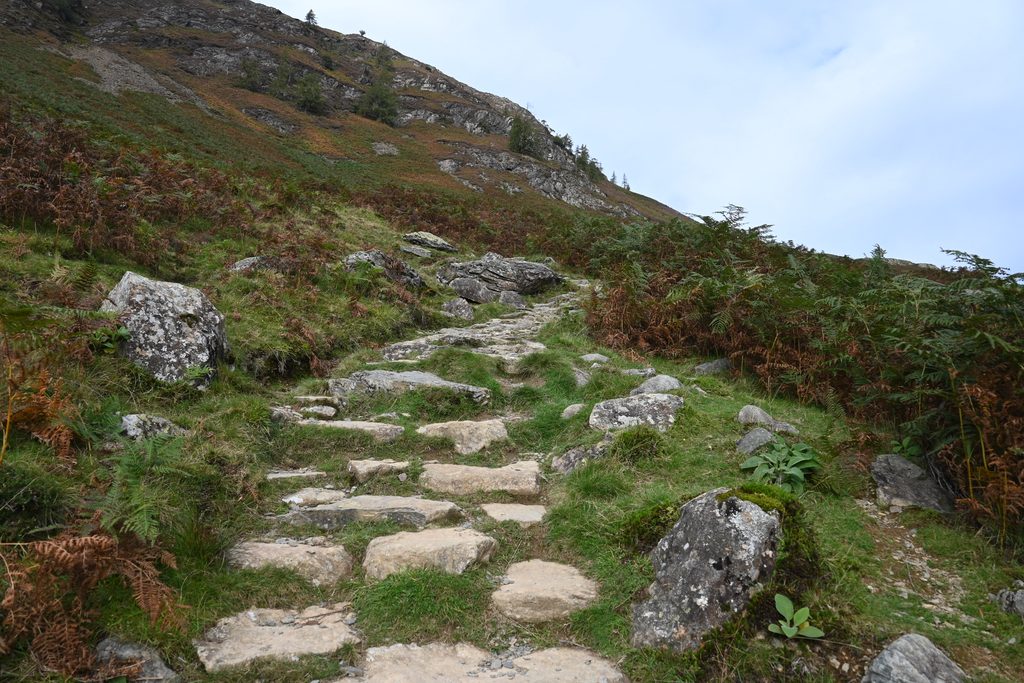
The path up to the top of Catbells Fell
I stood on top of the mountain, admiring the magnificent view, but my heart sank when I looked at the steep descent stretching out before me. I was standing on the rocky summit of Catbells Fell in the Lake District of Northern England. In many countries, this would probably be considered a hill, but my wife and I had huffed and puffed our way up to its 1,500-foot summit. Now, we had to find a way down.
Just two weeks earlier, I had suffered a major fall while riding as a passenger on a bus that was involved in an accident on a freeway near Los Angeles. I had sustained multiple injuries, including a small fracture in my lumbar spine. The back pain had been excruciating, and I had seriously considered canceling our trip. We had been planning this weeklong hiking adventure in England for more than a year, and I was reluctant to give it up. I took painkillers, used heating pads, applied topical pain medications, and underwent physical therapy. Fortunately, about two days before we were due to begin our adventure, I was feeling considerably better. I decided to take a chance and go ahead with the trip.
Little did I know what awaited me.
From Los Angeles to the Lake District
We arrived in London late one afternoon after an overnight flight from Los Angeles. We spent the night in a hotel near Euston Station. The following morning, we boarded a train to Penrith, arriving in the afternoon. A taxi driver met us at the station and whisked us through the beautiful English countryside to Borrowdale, a small village nestled in a valley of the same name.
Our hotel was magnificent, a handsome stone building surrounded by farms and woodlands and situated on the banks of a fast-flowing river. The sound of rushing water provided a soothing backdrop to the peaceful countryside. After a magnificent dinner, we retired for the night and slept very well.
The following morning, we enjoyed an early breakfast, packed a light lunch, and prepared to begin our hiking adventure.
We had booked our trip through an adventure travel company that arranged our accommodations and suggested hiking routes. One of the great conveniences of this arrangement was that the company transported our luggage from one town to the next while we hiked. All we had to carry were our daypacks containing food, water, rain gear, and other essentials. We followed the suggested routes using maps and directions on the company’s app, which were generally easy to navigate.
That day, we were to hike from Borrowdale to Keswick. We had two options: an easy stroll along the banks of Derwentwater, the beautiful lake near Keswick, or a more strenuous six-mile hike over Catbells Fell. The latter involved climbing approximately 1,500 feet before descending the mountain and continuing into town.
Naturally, we chose the more challenging option. Why take the easy route when you can make life difficult for yourself?
The Climb to Catbells Fell
The first part of the hike was uneventful. A thick fog hung over the valley, and droplets of water fell from the ancient trees as we walked beneath their branches. Birds of all shapes, sizes, and colors chirped overhead, while sheep lounged in the seemingly endless green fields. It was a quintessential English countryside scene, peaceful and beautiful, with the mist adding a touch of mystery to the landscape.
We found the trailhead about half a mile from our hotel. The path began with a gentle climb, but before long, we were tackling steep steps carved into the mountainside. As we gained elevation, the terrain became increasingly rugged. The trail grew rockier and steeper, and the climb became considerably more challenging.
We stopped occasionally to catch our breath and rest our aching legs. Given my recent back injury, I was particularly conscious of every step, although I tried not to think too much about it.
Just before reaching the summit, we came upon a small grassy hollow. The views from there were stunning. We could see lakes, valleys, and villages spread out below us, with surrounding mountains rising in every direction. The clouds and mist added to the drama of the landscape, and we paused to take in the magnificent 360-degree panorama.
But the hardest part of the climb was still ahead.
The path became increasingly difficult, with sharp rocky outcroppings, unstable boulders, and narrow ledges. We carefully picked our way over the uneven terrain, concentrating on where we placed our feet. Eventually, after considerable effort, we reached the summit.
A handful of other hikers were already there, admiring the view and taking photographs. We joined them, took a selfie, and congratulated ourselves on our achievement. We had made it!
Then I suddenly realized something else: it was my birthday, and I had entered the last third of my life.
What better way to mark a milestone birthday than by climbing a mountain in England?
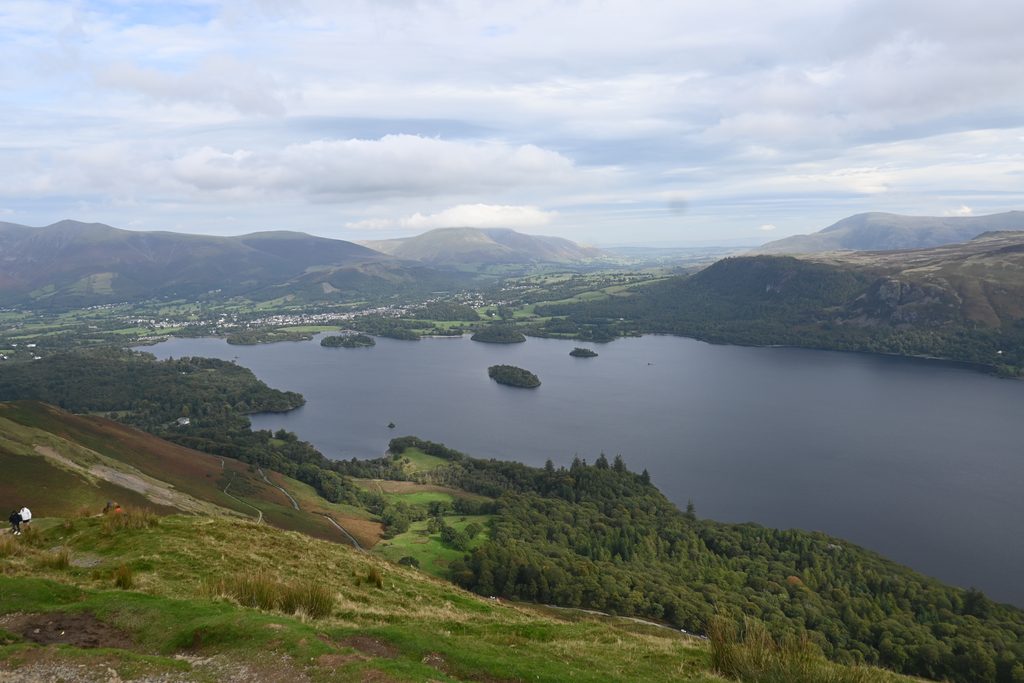
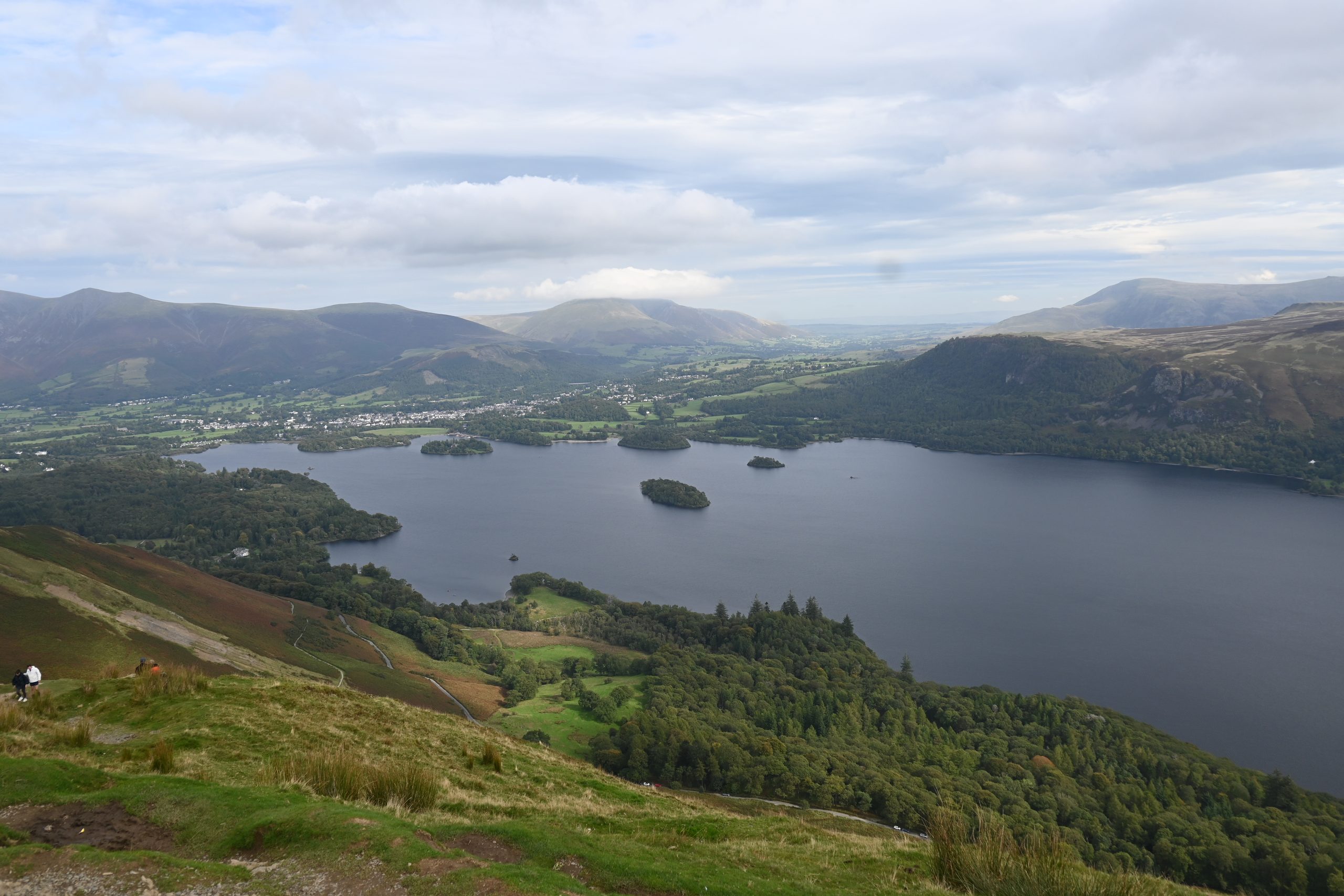
Views of Derwentwater Lake from the top of Catbells Fell
To celebrate, we sat on a flat rock, opened our packed lunch, and I took out a banana and ate it. There was no birthday cake, no candle, and certainly no champagne. Just a banana on top of a mountain, with a spectacular view as my birthday present.
We had planned to celebrate properly over dinner that evening in Keswick. For the moment, I was content to enjoy the view and the satisfaction of having made it to the top, especially after my recent accident.
Unfortunately, I had not yet appreciated the challenge that lay ahead.
The Descent from Hell
After resting for a while, we headed toward the other side of the mountain to begin our descent. That was when I looked down and felt my heart sink.
The route ahead was a jumble of jagged rocks, enormous boulders, and narrow ledges. There was no clearly defined pathway, just a seemingly endless stretch of uneven rock leading down the mountainside.
To make matters worse, I saw an older woman slip and fall onto her hands and knees about a hundred feet below us. She waved to the people around her to indicate that she was all right.
And then, as if the situation were not challenging enough, it began to drizzle. Before long, the drizzle turned into fairly heavy rain.
We put on our raincoats and prepared to descend.
Even with hiking poles and sturdy hiking shoes, negotiating the slippery, uneven rocks was treacherous. Every step required careful consideration. One wrong move could mean a twisted ankle, a broken bone, or an even more serious injury. Given my recent back fracture, the consequences of a fall were almost too frightening to contemplate.
My wife decided that the safest way to proceed was to sit on a rock and slide down from one rock to the next. It was hardly the conventional way to descend a mountain, but it seemed sensible under the circumstances.
I tried to follow her example. Unfortunately, I was not nearly as adept at it. Several times, I nearly lost my footing and toppled over. I was terrified of twisting an ankle or, worse, breaking a bone. After all, I had only recently recovered enough from my previous accident to undertake this trip. The thought of another injury, far from home and in the middle of the English countryside, was deeply unsettling.
We soon passed the woman we had seen fall earlier. She had bruises on her exposed arms and legs and had decided to sit on a rock and rest for a while. She appeared to be taking things in stride, but the incident reinforced our awareness of how dangerous the descent could be.
It took us more than 30 minutes to negotiate the rocky face of the mountain, descending perhaps two or three hundred feet. Those were among the most nerve-racking minutes of our entire trip.
Eventually, we made it past the worst of the rocks and onto a much smoother path. The rest of the descent was considerably easier, although my back had begun to hurt again. The backpack stuffed with jackets, raincoats, cameras, food, and water suddenly felt much heavier than it had that morning. My feet were tired and aching, and I was beginning to question the wisdom of our decision to take the more challenging route.
We eventually reached a paved road running alongside the lake. According to the trail directions, we still had another two miles to walk into town.
Two miles! After everything we had been through, even that relatively short distance seemed daunting.
Fortunately, we spotted a young couple sitting on a log beside the road. We approached them and asked for directions. They told us that they had just come down the mountain themselves and were too exhausted to walk into town. They were waiting for a bus.
That sounded like an excellent idea. We decided to join them.
A Bus Ride to Remember
Before long, a small crowd of tired hikers had gathered along the roadside, all waiting for transportation into town. We were relieved to discover that we were not the only ones who had decided that walking another two miles was more than we could manage.
Suddenly, a red double-decker bus came speeding down the hill and screeched to a halt beside us.
We climbed aboard, only to discover that the bus was crowded and there were no seats available. We had no choice but to stand, clutching the straps and poles for dear life as the bus set off.
What followed was another adventure, although not one we had deliberately chosen.
The bus hurtled along the narrow, winding road, swerving around sharp bends and seemingly coming perilously close to cars approaching from the opposite direction. At times, it felt as though we might sideswipe an oncoming vehicle. We struggled to maintain our balance as the bus lurched from side to side.
The 15-minute ride was an ordeal in itself. By the time we reached town, I began to wonder whether walking those two miles might actually have been the better option!
At least we had survived the mountain, the rain, and the bus ride.
Or so we thought.
When we got off at the central bus station in Keswick, we discovered that our hotel was another two miles away, uphill from the station. There were no taxis available.
We looked at each other, sighed, and began walking.
By then, the rain was pouring down, my back was aching, and our legs were exhausted. We trudged uphill through the rain and finally reached our hotel in the early evening, thoroughly drenched and utterly spent.
The moment we entered our warm room, we collapsed onto the bed. We were so exhausted that we lay there almost motionless, barely able to summon the energy to speak.
After a short, rejuvenating nap and a hot shower, however, we began to feel human again. We had a birthday to celebrate, after all!
We headed into town and found a popular, crowded restaurant. Unfortunately, all the tables were occupied, and the only seats available were at the bar counter. We settled in, ordered dinner and wine, and enjoyed an excellent meal.

The popular restaurant where we celebrated my birthday at the bar counter
As we ate, we laughed about our foolish adventure: the difficult climb, the terrifying descent, the rain, the bus ride, and the seemingly endless walk to our hotel.
In retrospect, the day had been exhausting, frightening, and physically demanding. But it had also been exhilarating. We had conquered a mountain, celebrated a milestone birthday in a rather unconventional fashion, and acquired a story we would remember for years.
Perhaps that was not such a bad way to celebrate a birthday after all.
Lost in the Woods
The following morning, we faced another decision. Among the available hiking options was a visit to Castlerigg Stone Circle, one of the most famous prehistoric stone circles in England.
This time, we opted for what was described as the easy hike.
You would think we had learned our lesson. But no! Once again, we chose the longer route, a walk of approximately five to six miles.
Our adventure began almost as soon as we reached the edge of town. We lost our way and had to ask other walkers and hikers for directions. Before long, our GPS stopped working, and we found ourselves wandering through a heavily wooded area with little idea of where we were supposed to go.
We were uncertain about how to proceed when we encountered an elderly man walking alone along the trail. He graciously offered to let us follow him.
We gladly accepted his offer.
The walk through the woods was beautiful. A fast-flowing stream ran alongside us on the left, while magnificent trees surrounded us on every side. The air was fresh and cool, and the sound of rushing water provided a soothing soundtrack to our walk. For a while, we forgot our navigational troubles and simply enjoyed the beauty of the English countryside.
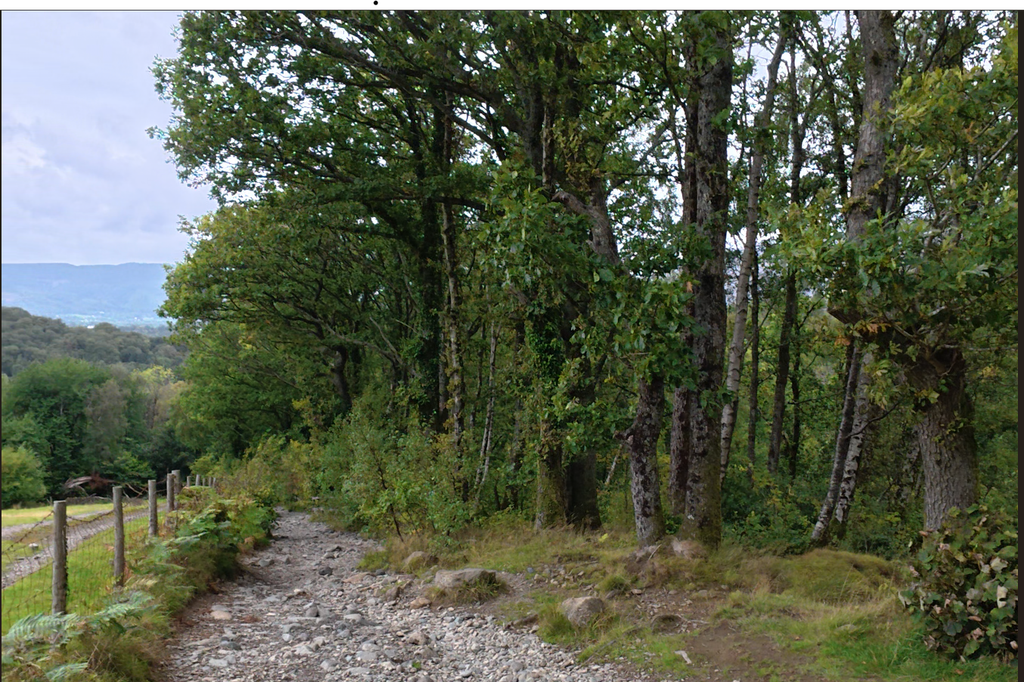
Hiking through the beautiful woods on our way to the Stone Circle
Eventually, we reached a fork in the trail. Our guide turned left and instructed us to take the path to the right. He explained that if we followed it until we reached a road, we would find signs directing us to the stone circle.
We thanked him for his help and continued on our way.
The woods were peaceful, and the only sounds were the gushing stream to our left and the crunch of our footsteps along the path. After a while, the trees began to thin, and suddenly we emerged from the woods onto a road.
There it was: a sign pointing to the right toward Castlerigg Stone Circle.
We were back on track!
The pathway led us through open fields that formed part of privately owned farms. Although the land belonged to individual farmers, the government had secured a public right of way, allowing walkers and hikers to cross the properties.
The grass was still soggy from the rain that had fallen the previous day and night. Before long, our boots were sinking into the mud, and we were struggling to keep our balance on the slippery ground.
Meanwhile, dozens of sheep grazed peacefully in the fields. Every now and then, they would stop chewing, raise their heads, and stare at us as we struggled through the mud.
I swear they were laughing at us.
Perhaps they were wondering why two grown adults would willingly spend their holiday trudging through muddy fields when they could have been enjoying a comfortable afternoon indoors.
Between the farms, gates provided access to the next stretch of the path. We opened and closed them as we made our way from one property to another, following the marked route.
We must have crossed through about ten farms before finally reaching another road, where numerous cars were parked.
At last, we had arrived!
The Ancient Stones of Castlerigg
We walked into the enclosed area of Castlerigg Stone Circle, which was surrounded by a wall and a gate. The site was impressive, although not on the scale of Stonehenge.
A nearby sign informed us that the stone circle was approximately 4,500 years old. Standing among those ancient stones, I tried to imagine the people who had erected them thousands of years ago, long before modern roads, towns, and the conveniences of our daily lives.
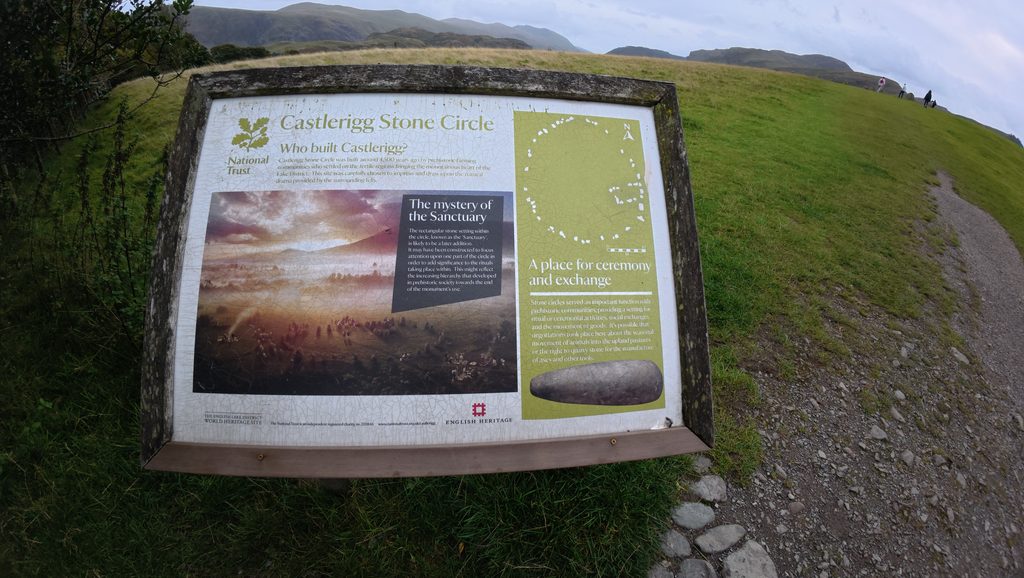
Sign at the entry to the Castlerigg Stone Circle
Who were they? Why had they chosen this particular location? What ceremonies or gatherings have taken place here?
The stones stood silently against the surrounding landscape, their weathered surfaces bearing witness to the passage of millennia. Unlike a modern monument, the circle seemed to belong naturally to the landscape, with the surrounding hills and countryside forming an integral part of the experience.
We spent about half an hour walking around the circle, studying the stones and taking in the atmosphere. After the muddy walk through the farms and our earlier navigational mishaps, it was satisfying to reach our destination.
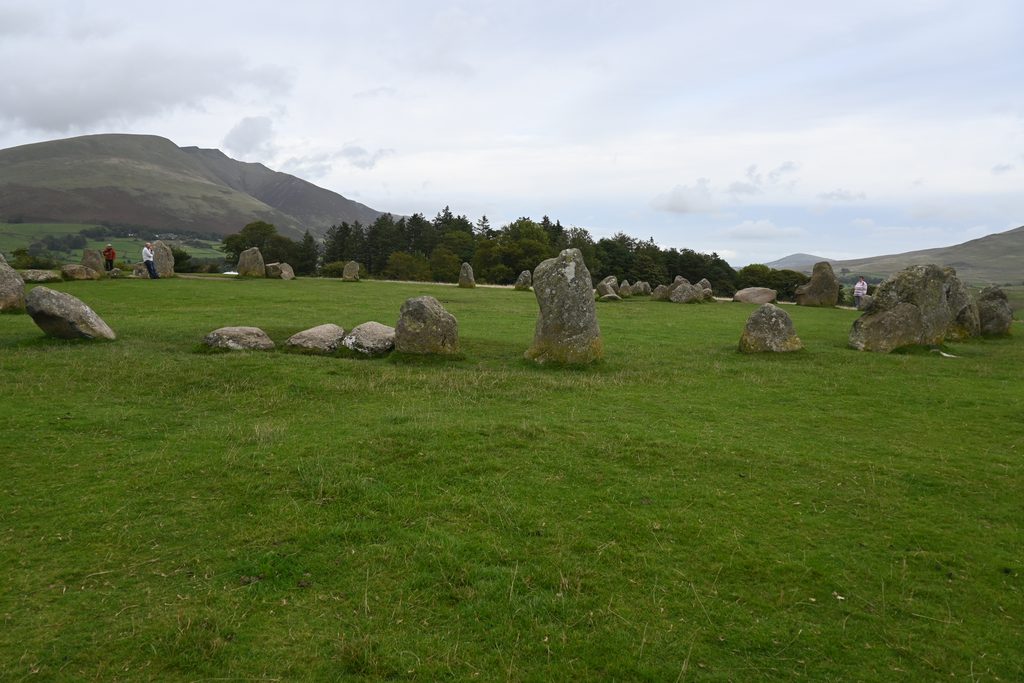
The Stone Circle
This time, we decided not to tempt fate by taking another long route back. We followed the shorter path into town and returned to our hotel by late afternoon.
Our hotel did not have a restaurant, so we had to walk into town again for dinner. By then, walking had become such a regular part of our day that we barely questioned it.
When we finally returned to our room, I checked my fitness app.
We had walked more than 25,000 steps that day, covering approximately 12 miles!
So much for an easy hike.
Leaving the Lake District
The following morning, our taxi arrived early to take us to Carlisle railway station. From there, we boarded a train bound for Leeds.
The journey itself was a delight. The train traveled through magnificent countryside, passed through multiple tunnels, and crossed the spectacular and historic Ribblehead Viaduct, which has been in use since 1876.
As we left the Lake District behind, we entered the Yorkshire Dales, another beautiful region of Northern England, known for its rolling hills, green valleys, stone walls, and picturesque villages.
From the train window, far off in the distance on our right, we could see remnants of Hadrian’s Wall (or so I mistakenly thought as it turned out later), the nearly 2,000-year-old Roman fortification built across northern England.
It was fascinating to travel through a landscape so steeped in history. Within a relatively short time, we had moved from the mountains and lakes of the Lake District into the rolling countryside of Yorkshire, with reminders of Roman Britain visible in the distance.
We got off the train in the small town of Settle and discovered that our hotel was about two miles away, in the neighboring village of Giggleswick.
By then, we were beginning to feel that every destination in England came with an additional two-mile walk!
We dragged our heavy suitcases along uneven cobblestone streets and uphill toward the hotel. It was not the most enjoyable way to explore a village, especially after two days of strenuous hiking and with my back still bothering me.
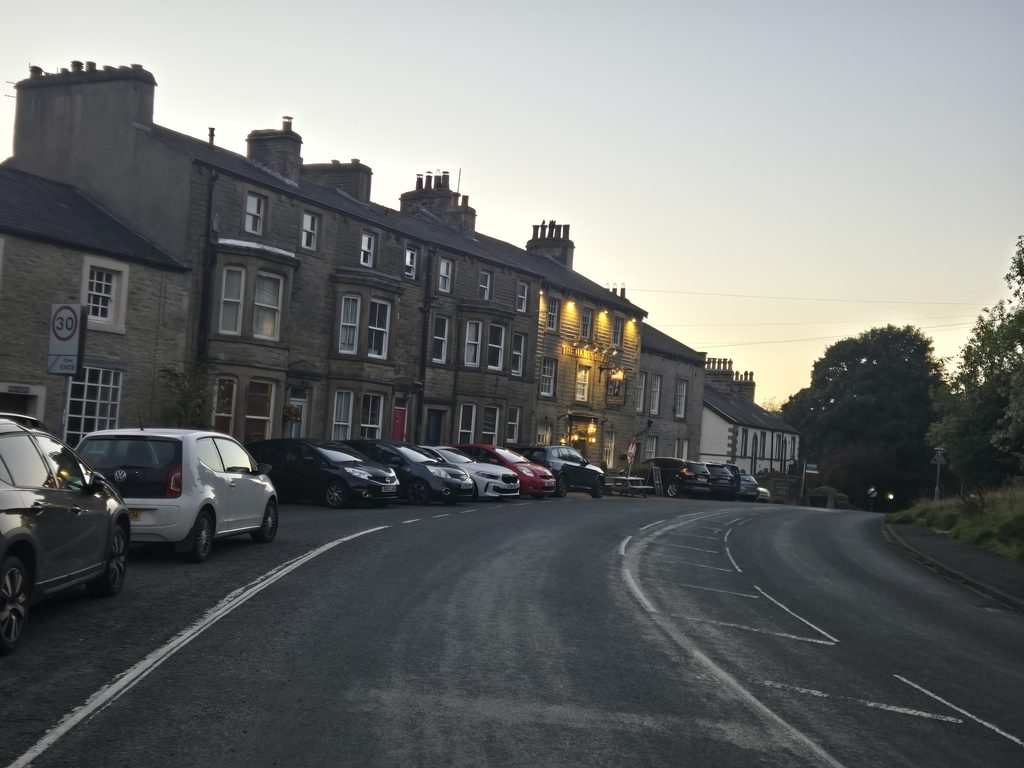
The road to our hotel in Giggleswick
Our hotel was housed in a historic, three-story stone building that was about 200 years old. The guest rooms were located above a popular pub, giving the place a distinctly traditional English character.
Unfortunately, there was no elevator. We had to carry our heavy luggage up the stairs ourselves.
By this point, my back felt as though it was ready to give out.
After resting for a while, we walked back to Settle to explore its small shops. The town had a charming, old-fashioned character, with traditional stone buildings and narrow streets that seemed to belong to another era.
We eventually settled into a small, beautiful restaurant for dinner. After the long journey and the struggle with our luggage, it was a welcome opportunity to relax and enjoy a good meal.
Another Day, Another Hike?
The following morning, we were scheduled to hike eight miles through the Yorkshire Dales to the village of Malham, crossing hills and valleys along the way.
The route promised more beautiful scenery and another opportunity to experience the English countryside on foot.
But there was one problem.
My back was hurting, my legs were tired, and I had already endured three days of intense travel, long walks, steep climbs, slippery rocks, muddy fields, and a rather terrifying descent from Catbells Fell.
As we prepared for bed that evening, I began to wonder whether we should attempt the eight-mile hike or simply hire a taxi and travel to Malham in relative comfort.
For once, I seriously considered choosing the easy option.
Would we be able to manage another full day of hiking? Would my back hold up? And, perhaps most importantly, had we finally learned our lesson about choosing the more strenuous routes?
Those questions would have to wait until morning.
I fell asleep almost as soon as my head hit the pillow, utterly exhausted after three days of intense travel.
Whether we would lace up our hiking boots again or surrender to the comfort of a taxi was still undecided.
But that is another story.
Part 2 of Hiking in England is coming soon. It is about hiking in the Yorkshire Dales National Park